How to play Mycelium
Everything you need to know to play: the one rule that decides every match, how biomass works, how to attack, and what the two abilities do. Reading it takes about ten minutes. Playing the in-game tutorial takes two.
What kind of game is it?
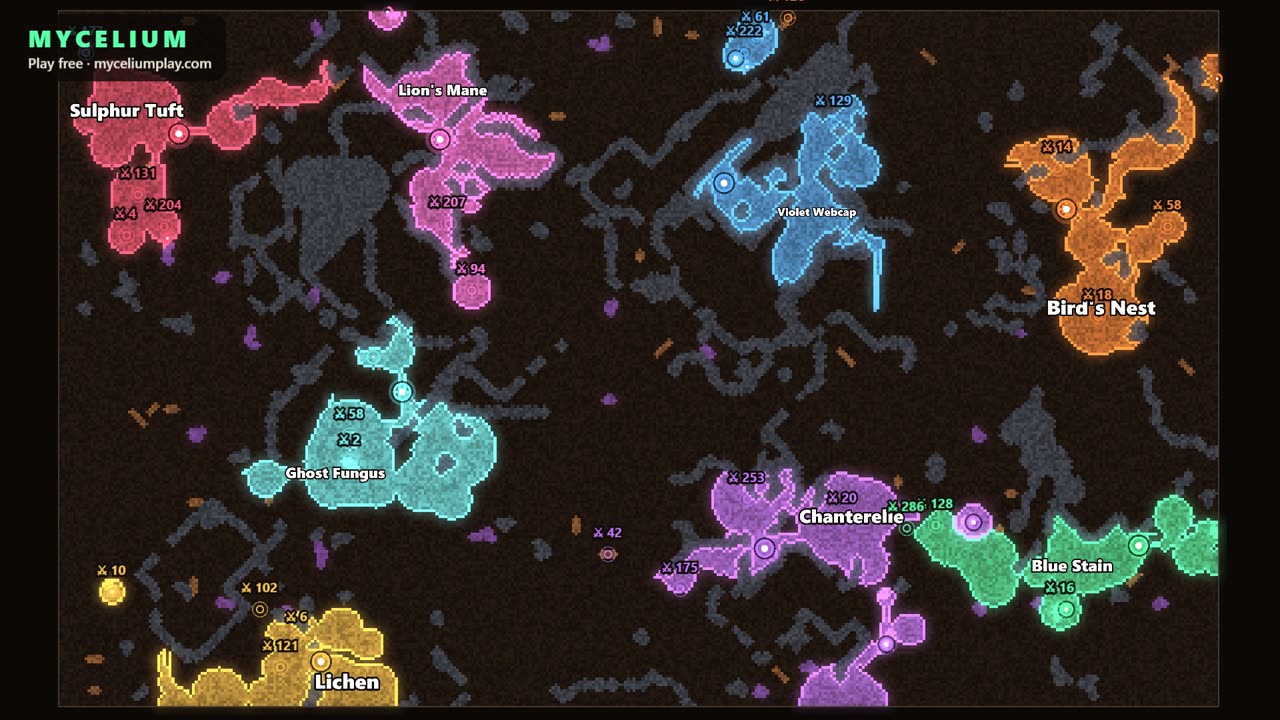
Mycelium is a real-time territory strategy game that runs in your browser. Each player is a fungus growing underground on a map of soil and rock. You spread your network into free soil, fight your neighbours for territory, and try to absorb every other colony. The last fungus alive wins. A match usually lasts two to four minutes.
If you have played territory games like Territorial.io or OpenFront, the basics will feel familiar: you send a share of your resources toward a point and your territory grows that way. What makes Mycelium different is the way your land is held together.
The one rule: keep your network connected
Every colony starts from an origin, the glowing ring at its heart. A cell of your territory only counts if it is connected to your origin through your own cells, moving up, down, left or right (not diagonally). That connection is your supply line.
If an enemy takes a strip of your land and splits your network in two, everything on the far side of the cut is cut off. Cut-off cells stop earning biomass, flicker with a pale outline, and die after 3 seconds. If you reconnect them in time, by growing a new path back to them, they heal instantly.
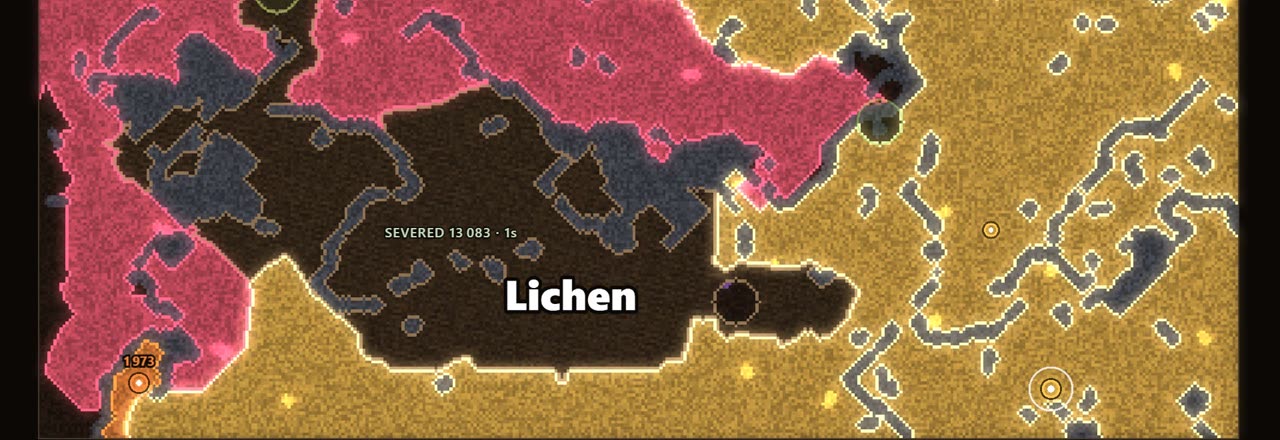
This rule decides most matches. A big colony with one thin neck is weaker than it looks. A small colony that cuts that neck at the right moment can take half the map in three seconds. Cut-off cells also cost the attacker almost nothing to take, so a good cut is followed by a cheap land grab.
Biomass: your only resource
Everything costs biomass, shown at the bottom of the screen. It grows on its own, ten times per second:
- every colony earns a base of 10 biomass per second;
- each connected cell adds 0.08 per second, so 1,000 connected cells earn about 90 per second;
- connected nutrient soil adds more (see bonuses below).
Biomass has a cap: 200 plus 3 per connected cell. When you are full, growth stops, so stockpiling forever wastes income. Cut-off and withering cells don't count for income or for the cap.
Growing and attacking
Left-click anywhere on the map to send biomass toward that point. The Send slider (or the number keys) sets how much: 1 sends 10% of your biomass, 5 sends 50%, 0 sends 100%. A label next to your mouse always shows how much a click will send.
- Click free soil to expand. Your colony grows from its border toward the point you clicked, one ring of cells at a time.
- Click an enemy to attack that enemy only. If your borders don't touch yet, your growth crosses free soil first, then bites into their land.
- Bigger sends grow faster: more biomass means more cells taken per tick.
- Whatever an attack doesn't spend comes back to you when it ends.
What each cell costs
| Cell | Cost |
|---|---|
| Free soil | 1 biomass |
| Enemy cell that is cut off from its origin | 1 biomass |
| Healthy enemy cell | 3 + half the enemy's biomass per cell (10 at most) |
| Rock or water | Impossible: nothing grows there |
So a colony sitting on a big stock of biomass is expensive to attack, while a colony that just spent everything is cheap. Attacking healthy enemy land is also a bit slower than expanding into free soil, which gives defenders time to react.
Counter-attacks clash
If someone is attacking you and you attack them back, the two attacks meet and cancel each other out: both lose the same amount. 5,000 against 5,000 leaves nothing; 7,000 against 5,000 leaves 2,000 of yours to carry on. Answering an attack quickly is often the best defence.
Map bonuses
- Nutrient soil (violet patches): each cell gives +0.5 biomass per second for as long as you hold it and it is connected. A full patch can double a young colony's income.
- Rotting logs (brown): +8 biomass per cell, once, for whoever reaches them first.
- Roots (pale amber, only on the Root Highways map): free soil on a root costs a third as much and your growth races along it about three times faster.
The two abilities
Right-click a spot to open the ring menu, or press Q / E and click. Both abilities reach up to 12% of the map's longer side from your territory (24 cells on a Medium map), and both recharge in 15 seconds.
Spore burst (Q)
Sends your Send percentage of biomass flying to a spot near your land. A quarter of it is lost on the way. The spore takes off from your closest cell, flies for up to two seconds (everyone sees it coming), and starts a new little colony where it lands. On free soil it grows; on an enemy it bites into their land.
The landing spot keeps its colony alive for 10 seconds. Link it to your network in time, or grow it to 120 cells: then it takes root and becomes a permanent second heart that keeps everything around it connected. That is how you hold islands on the Archipelago map.
Mycotoxin (E)
Costs 150 biomass and drops a poison cloud for 12 seconds. Every cell inside it withers, your own included, so place it carefully. Enemy cells inside cost you only 1 biomass to take. Origins and rooted spores are immune, and you can't drop a cloud right next to an enemy origin.
Clouds also stop spores: an enemy spore that lands inside your cloud dies, and the cloud is used up. When the game warns you that a spore is coming down on your land, a cloud on the landing spot is your shield.
Absorbing colonies and winning
Take an enemy's origin and you absorb them: they are out, and you get all their biomass (including what was still in their attacks) plus 1 per cell they owned. Their remaining land is cut off and withers away. Keep going until you are the last colony alive.
Starting a match
- Solo: pick a map style, a size, 1 to 7 bots and their difficulty, then press Start.
- Quick play: join a public match with anyone online. It starts 20 seconds after the first player joins, and bots fill it up to six colonies.
- Private room: create a room and share its four-letter code. The host picks the settings, and the room stays open after each game so you can play again.
Every match opens with a short spawn phase: click the map to choose where your colony starts (not too close to anyone else), then press Start now (solo) or I'm ready (online).
Controls
| Action | Control |
|---|---|
| Expand or attack | Left-click |
| Ability menu | Right-click |
| Aim Spore burst / Mycotoxin | Q / E, then click (Esc cancels) |
| Send 10% … 90% / 100% | 1 … 9 / 0, or Shift + mouse wheel |
| Move the map | Drag with any mouse button, or the arrow keys |
| Zoom | Mouse wheel |
| Center on your colony / whole map | C / Space |
| Pause (solo only) | P |
| Sound on / off | M |
Bot difficulties
- Easy: grows slowly (20% less income) and rarely attacks. Good for learning.
- Normal: expands steadily, likes bonuses, picks fights when it is clearly stronger.
- Hard: thinks faster, retaliates, cuts supply lines and uses spores and mycotoxin.
- Brutal: everything Hard does, with 20% more income. A real challenge.
Play Mycelium free