Strategy guide: how to win at Mycelium
Mycelium is easy to start and hard to master. These tips go from your first minute to the endgame. If you haven't played yet, read How to play first: everything here builds on the supply-line rule.
The opening (first 30 seconds)
Pick a good spot during the spawn phase
You get twenty seconds to move your starting colony. Look at the map preview: a spot with open soil around it grows faster than one wedged against rock, and a spot near violet nutrient soil pays you back for the whole match. Starting next to a narrow passage is good later (it's easy to defend) but slow early.
Grow in several directions, with medium sends
Early on, free soil only costs 1 biomass per cell, and your income depends on how many connected cells you have. Sending around 30 to 50% at a time toward a few different directions grows you faster than one giant push, because each attack only grows from the part of your border that faces its target.
Grab nutrients first, logs when they're on the way
A nutrient cell gives +0.5 biomass per second for the rest of the match, as long as it stays connected. A patch of twenty cells is worth +10 per second, as much as your whole base income. Logs are a one-time gift (+8 per cell): nice when they're on your path, not worth a detour.
Protect your own supply lines
Most matches are lost, not won. The classic mistake is a long, thin arm of territory reaching toward a bonus or an enemy. One cut and everything past it withers in three seconds.
- Widen your necks. After a long push, send a small expansion along the sides of the path to make it thicker. A path three cells wide is much harder to cut than one cell.
- Grow in blobs, not lines. A round colony has its origin far from every border; a snake has its origin close to all of them.
- Watch the pale outline. Cut-off land gets a pale edge and a countdown. You have three seconds: a quick expansion aimed right at the gap reconnects it and heals every cell.
- Keep some biomass in reserve. Your healthy cells cost enemies 3 plus half your biomass per cell, up to 10. A colony that keeps a stock is expensive to attack; a colony at zero is a buffet.
Attacking: cut first, absorb later
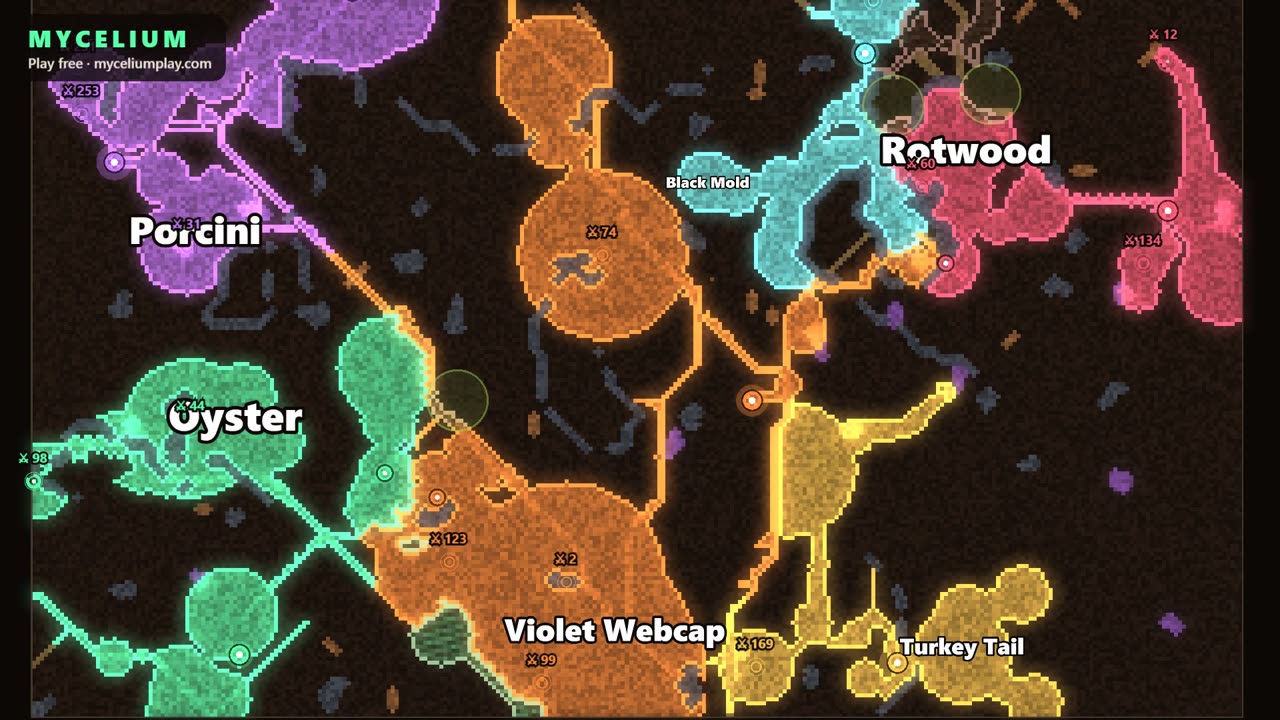
Running straight at an enemy's origin is the most expensive way to win. Their healthy cells cost up to 10 each, and they have time to answer. The efficient way is to cut:
- Find the thinnest part of their territory: a neck, a corridor between rocks, a long arm.
- Click right on it with a solid send. Taking a few cells there splits their network.
- Everything past the cut is now cut off: it costs you only 1 biomass per cell, and it dies in three seconds anyway. Grab it, or let it wither.
- Their income drops with the land they lost. Now go for the origin.
A colony that just made a big push has spent its biomass and is cheap to hit. Watch the attack list at the top left: a big outgoing attack from a neighbour is your window.
Defending: answer attacks fast
Incoming attacks show in red at the top left, with the biomass left in them. When one comes, the best answer is usually to attack the attacker back: your attack clashes with theirs and both lose the same amount. If you answer with as much as they sent, their attack simply disappears. Counter-attacking also threatens their now-weakened border.
If you can't match the attack, protect what matters: reinforce the neck that leads to your origin, and let an outlying arm go rather than losing your heart.
Using Spore bursts well
- Steal a bonus. A small spore right onto a nutrient patch grabs it before anyone walks there.
- Open a second front. A spore behind an enemy's border bites into them from the inside, often right next to a neck you want to cut.
- Make it take root. A spore colony that reaches 120 cells becomes a permanent second heart. Send enough biomass (remember a quarter is lost in flight) and keep feeding it.
- Mind the timer. Unrooted spores keep their colony alive for 10 seconds. Plan to link up or to root before then.
Using Mycotoxin well
A cloud kills every cell inside it for twelve seconds, yours included, and makes poisoned enemy cells cost you just 1. Used well, it's the best way to cut a thick border:
- Drop it inside their land, not on the border. Centered a few cells into enemy territory, the cloud hurts them and spares you.
- Follow it up. The cloud alone only kills what's inside. Send an attack through it while it lasts to cut everything behind it.
- Use it as a shield. When the game warns you that an enemy spore is coming down on your land, a cloud on the landing spot kills the spore. You lose a few of your own cells, they lose their whole spore.
Map-specific tips
- Caverns, Labyrinth: rock ridges make natural necks. Hold the gaps; cut enemies at theirs.
- Chambers: rooms linked by tunnels. Whoever holds a tunnel decides who passes.
- The Rift: a few passes cross the big wall. Defend yours early.
- Open Soil: no chokepoints, pure speed. Income and timing matter most.
- Root Highways: race along roots to grab land far away, but every root is a long thin line. Expect to be cut, and cut back.
- Heartwood: the rich core pays enormously, but its four gates are traps. Hold one gate strongly before you pour in.
- Archipelago: islands only connect by spores and a few bridges. Root a colony on the next island early, and kill enemy island colonies by taking their rooted heart.
See all of them on the maps page.
The endgame
With two or three colonies left, everyone is big and every attack is expensive. Patience wins here:
- Let the other two fight each other. Strike the one who just spent the most.
- Absorbing a colony gives you all its biomass: a successful absorb often decides the match.
- Look for the giant cut. Late-game colonies stretch across the map, and one cut through the middle can remove half of an enemy at once.
Play Mycelium free